
Intimacy and Triumph
Water and Stone Part One
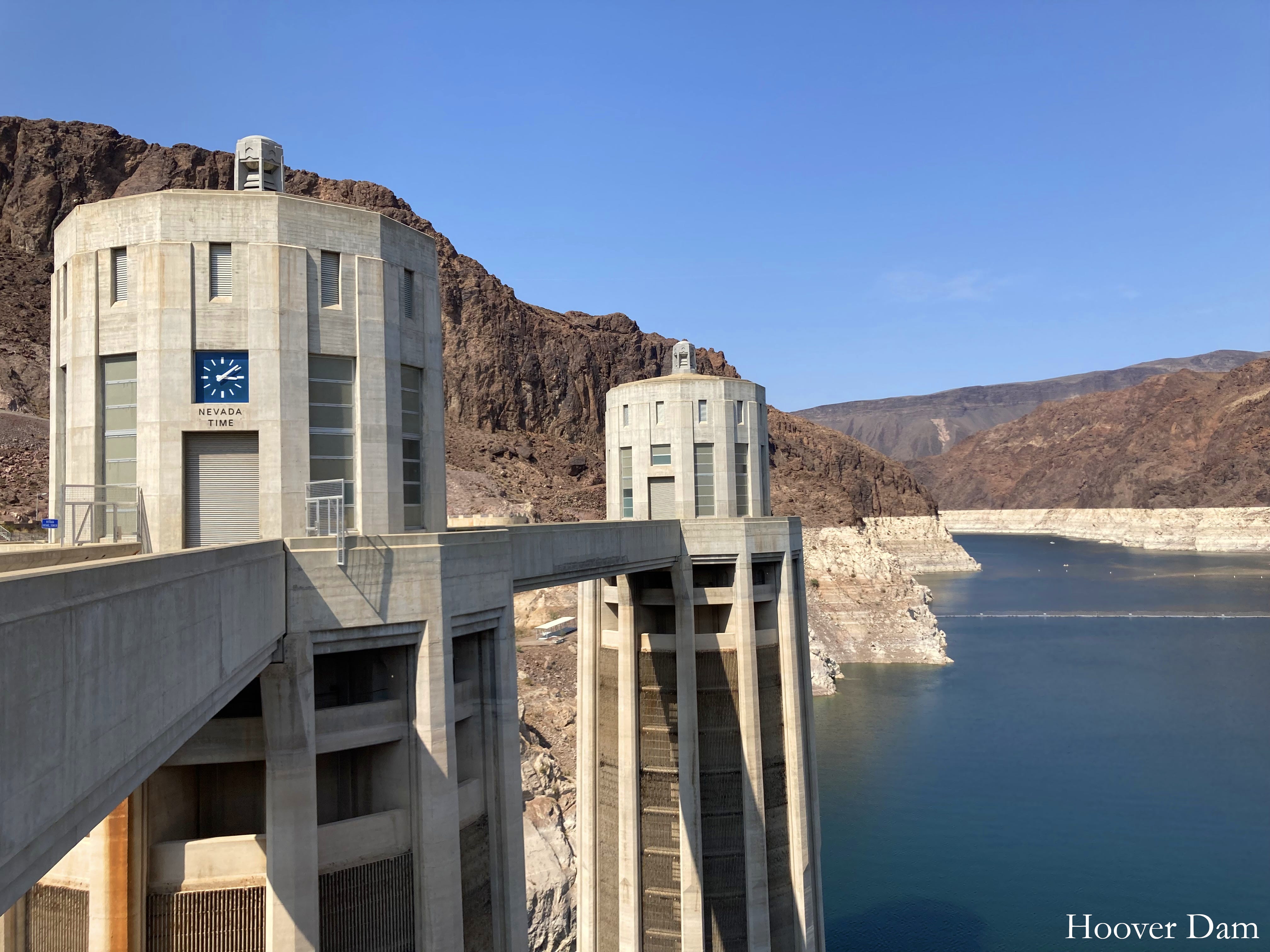
The Hoover Dam is an engineering marvel. It powers the bright lights of Los Angeles and quenches the limitless thirst of Las Vegas, those incarnations of American hubris.
It was built as a monument. Its Art Deco towers stand triumphant over the wide water of Lake Mead. Between bronze reliefs, plaques honor the 21,000 workers who labored on it and the 96 who died. Its crest is a walkway for tourists to marvel as if they were at the rim of the Grand Canyon. The visitor exclaims: “We have conquered nature and surpassed it.”
It was built at a time when the mastery of humans over our world was still in doubt, when we still had something to prove. Today, it’s hard to imagine the thrill of first believing that we might be capable of dominating nature. From the cradle, our generation was taught to take this power for granted, and to be disgusted with its excesses.
Newer dams are built to look as inconspicuous as 50 million tons of steel and concrete could possibly be. We rely on them, but we’re ashamed of what they say about us.
We are sorry that the dams around Niagara Falls have tamed half of the water’s force. We write laws to protect rivers and lakes against the worst of our own exploitation. We turn the industrial harbors at the center of our cities into shoreline walking paths.
But it’s hard to give up any control. We are still afraid to swim in the rivers we have cleaned. The manicured lawns along the harbor paths spark no enchantment in our hearts. Meanwhile, theologies of a lost state of nature dominate all sides of the political conversation.
We ache for a different relationship with the water — one of familiarity, not domination.
Not so long ago, the roles were reversed. The life-force and unpredictability of water was the realm of the gods. It’s why so many ancient myths, omens, and incantations revolve around rain, floods, and wells.
All these works place the power over water squarely in the divine world, but they contain a desperate hope that if we do something the exact right way — butter the gods up just enough or build a relationship with the right demon or wash our feet just right before pouring a libation — we can trick the gods into signing some of this power over to us.
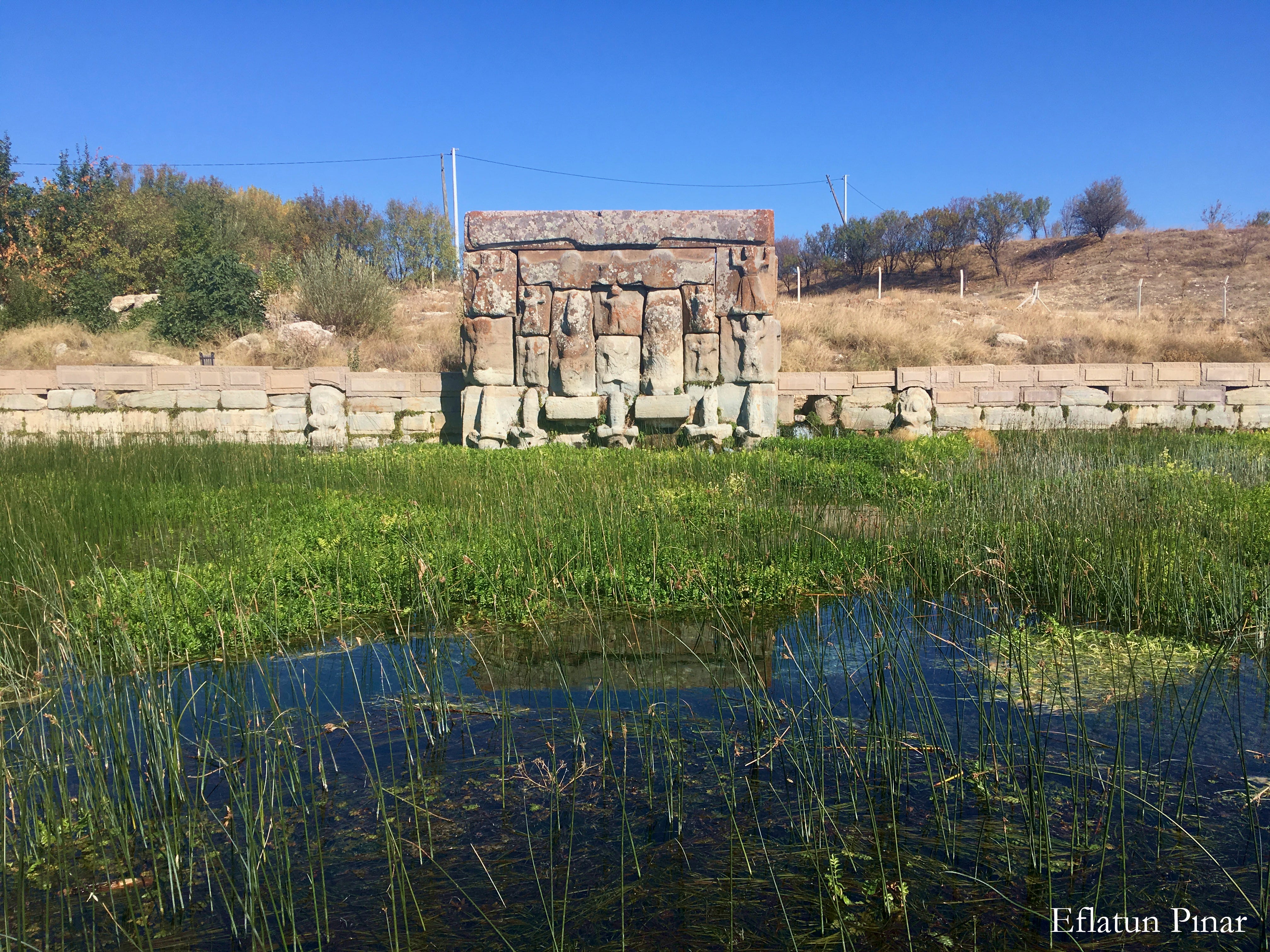
When Medieval travelers came upon Eflatun Pınar, a strange, ancient rock carving around a spring among the wheat fields of Central Anatolia, this is what they thought it was: a dam built to protect the wealthy city of Konya from the fury of floods, sealed with magical runes by Plato, whom local legend remembered as a miracle worker from Baghdad.
The monument wasn’t a dam at all. It was actually built by the Hittites in the 13th century BCE, 800 years before Plato was born, to fill a very different need.
~*~
The Hittite kings were without peers. It hadn’t always been the case; in the early days, their ancestors competed with other warlords for dominance over the rocky Anatolian Plateau. But by the 13th century BCE, those days were long gone. At least in public, the supremacy of the Hittite king was unquestioned. Those around him addressed him as “my sun-god.” The people of the kingdom were his servants, and the punishment for a presumptuous servant was the death of their entire family. If a king found a stray hair in his washbasin, the water carrier would be thrown in a river.
Fear made any intimacy with the king impossible.
There were other kings in Late Bronze Age Babylonia, Egypt, and Assyria. They sent letters back and forth, but they spoke different languages and rarely met in person. Besides, the correspondence was too public and too formal to be called friendship.
For that, the Hittite kings had to look to another plane of existence. Someone, out there, to finally speak plainly with.
And so, they tried to talk to the gods.
The gods answered, but only in riddles — in the flight of birds and the slithering of snakes. These messages were hard to trust. The kings often asked the same question again and again. The answer was different every time.
So the kings looked for a more direct connection. At first, they went for breadth, speed-dating every god whose reputation came across their path.
Every time they conquered a new group of people, the kings learned the names of their deities and built temples for them in Hattusha, their capital. Their empire became known as “the land of a thousand gods.” By the 13th century BCE, the metropolis of Hattusha, one of the world’s largest, was a city no longer. It was an endless collection of temples.
The temple rituals were thrilling. They included acrobats, tambourines, and flutes. There were wrestling competitions and comedic skits, maybe even public sex. But these festivities did not create the closeness the kings craved.
They believed that there was a divine realm in the watery place under the earth, and they began to search for a door to that world in every rock crevice, spring, and pond.
Hattusha was filled with such openings: a hidden tunnel under the Upper Town gate, a vast pool built among the temples, an artificial cave, every inch engraved with Luwian hieroglyphs, a series of rock crevices at Yazılıkaya, just outside the city, carved with the thousand gods of Hatti.
This was the true original purpose of Eflatun Pınar. Not a dam to confront the water, but a monumental gateway to approach it — to talk and to listen.
The water still bubbles in front of the watchful eyes of those stone gods, worn smooth by many patient years of coaxing us inside. Picnickers and stocking knitters recline against the sides of the pool. How could Medieval visitors have missed its intimacy?
The Hittites only began carving into the bare rock faces of Anatolia in the final century before the empire collapsed. But the carvings remained long after the Hittite armies went home and the tribute stopped flowing. In the centuries that followed, nostalgia-seekers and dreamers continued to visit them, admiring their dignified solitude and whispering rumors of the great kings who had carved them.
Centuries later, when Iron Age warlords wanted to think of themselves as kings, they added new rock carvings to the old.
The Hittites started a carving tradition that would continue to transform the mountains of Anatolia for over 2,000 years, into the Middle Ages. It would outlast the Assyrians, the conquests of Alexander, the conversion of Rome to Christianity, and the Muslim conquests.
But their meaning changed, somehow. Eflatun Pınar ceased to be a portal to communicate with the watery world and became a wall that demonstrated our power to keep it away.
In 2019, SaraNoa and I set out to experience as many of these rock carvings as we could to understand how this happened. We rented a car and traversed the landscape of monuments for five months, from the breezy seacoast to the stark, towering mountains to the high dusty plateau.
~*~
The first Hittite rock carving was commissioned by King Muwatalli II, just as he returned from the Battle of Kadesh against Egypt’s Ramesses II. It was the greatest stalemate of the Bronze Age, the permanent high-water mark for both empires.
Ramesses had commissioned a rock carving on the nearby coast of Lebanon on his previous campaign in the region. Perhaps Muwatalli was inspired by his encounter with that most prolific of Egyptian stone masons, even as he was disappointed by the end of the steady march of Hittite expansion.
But Muwatalli’s relief does not resemble Ramesses’s strident image, bursting forward, crushing enemy skulls. It’s not on a monumental temple wall or high on a cliff face.
It’s quite hard to find even if you’re looking for it.
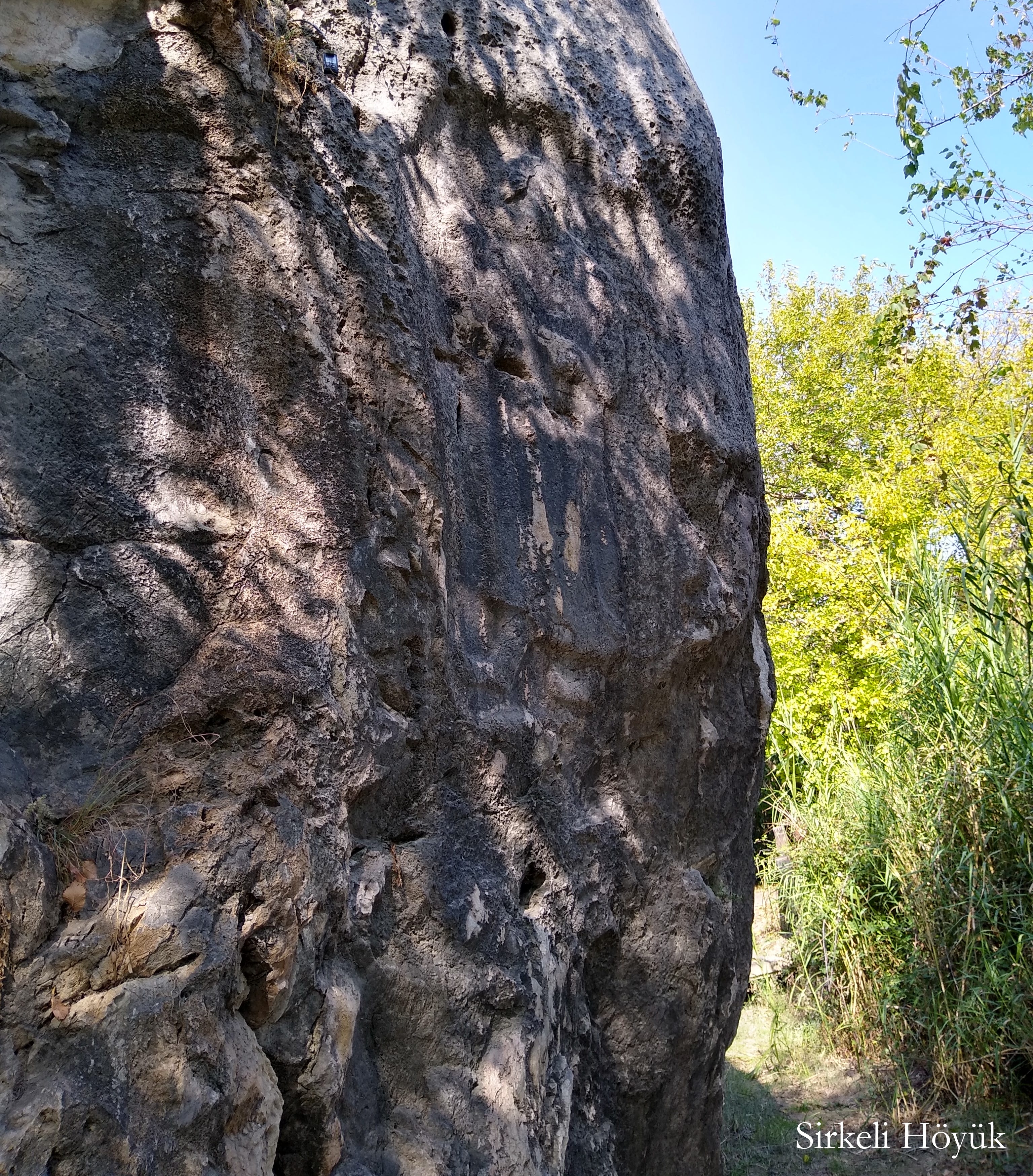
Muwatalli stands far beneath the acropolis of Sirkeli Höyük, a city in the Cilician plain, on the road back from Kadesh. The city drew life from the Ceyhan River, which tumbles from the Taurus Mountains, winding its way through the plain to the Mediterranean.
To find Muwatalli, you must balance on a narrow pathway that separates the acropolis cliff from the muddy, reed-filled river. There you stumble upon him, life-sized, eye-level, approaching the water with outstretched arms. He was the king of the largest empire on earth. He held the lives of tens of thousands in his hands.
Yet here he is, approaching the river as a friend. Unassuming, humble, attentive.
~*~
This image remained in the landscape far longer than the king’s authority.
Sirkeli Höyük lies on the old east-west road that traces the Mediterranean coast in the shadow of the Taurus Mountains. By the 4th century BCE, 900 years after Muwatalli’s death, it was a highway linking bustling mercantile cities, bounded on one side by water and the other by stone. Travelers continued to pass by Muwatalli’s relief, though they had long forgotten his name. The leading families followed his example and carved into the rocks that faced the sea.
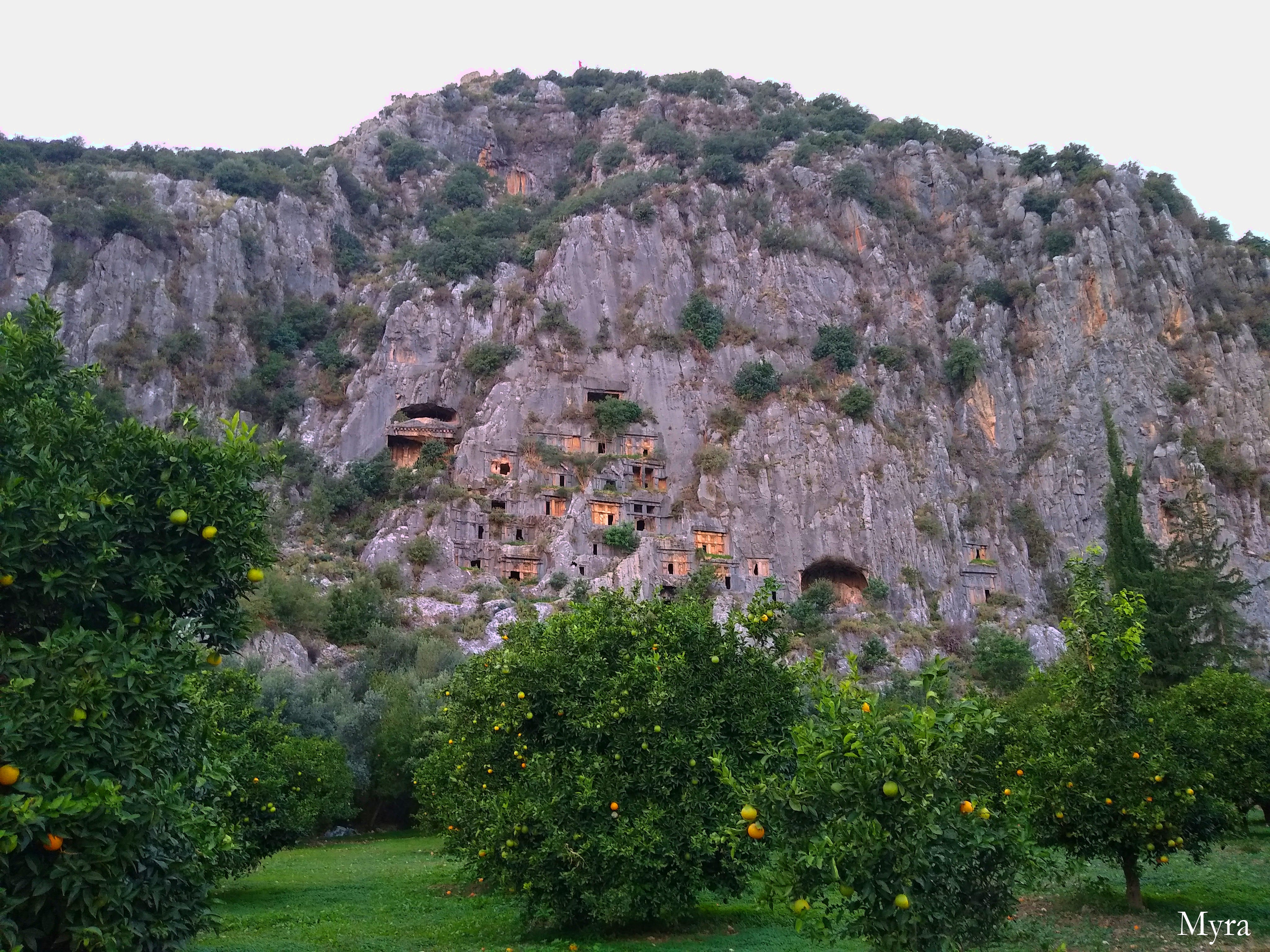
In Myra, they carved tombs in the shape of traditional log houses. They started, like Muwatalli, at life-size and close to the ground. Today, you can find them between the branches of orange trees heavy with fruit.
But unlike Muwatalli, these merchants did not feel any lack of friendship. They roamed from town to town alongside thousands of others. Each was searching for a personal advantage — a special bargain, a new market for their wares. They viewed the sea not as a source of solace, but as a life-threatening obstacle to be crossed, with copious treasure on the other side. All to outshine their drinking companions, to have a better story, a brighter necklace, a more striking robe.
In the years just before Alexander’s conquests, one merchant had passed through the Aegean and was impressed by the proud Greek temples he encountered there — straight and tall, simple in form, their crowns engraved with elaborate reliefs of heroes and monsters. He hired Greek stonemasons to make his own resting place in that style, sticking out from the house-tombs that already lined the cliffside.
But this wasn’t enough. He wanted to be higher up the cliff, directly on top of the tombs of his peers.
As we scrambled up the rock face and pulled ourselves into the temple tomb, we discovered that in trying to outdo his friends, the merchant had seized a new attitude towards the landscape itself. The river snaked below us to the broad, shining sea. The merchant and his mason had broken the sweet spell of intimacy and staked a claim on domination.
On the road back to Sirkeli, another necropolis cracks the towering rock face: Adamkayalar, built by a succession of merchant-priests in the decades around 200 BCE, beginning a century after the Myra temple tomb was completed.
The world had changed. By then, Alexander had conquered as far as stories of faraway wealth carried him in his short life. His successors fought for the right to his legacy, a never-ending game of “what would Alexander do,” played out in battles, self-portraits, and construction projects. Ostentation was the only path to survival. Greek-style temples began to crowd the Mediterranean landscape.
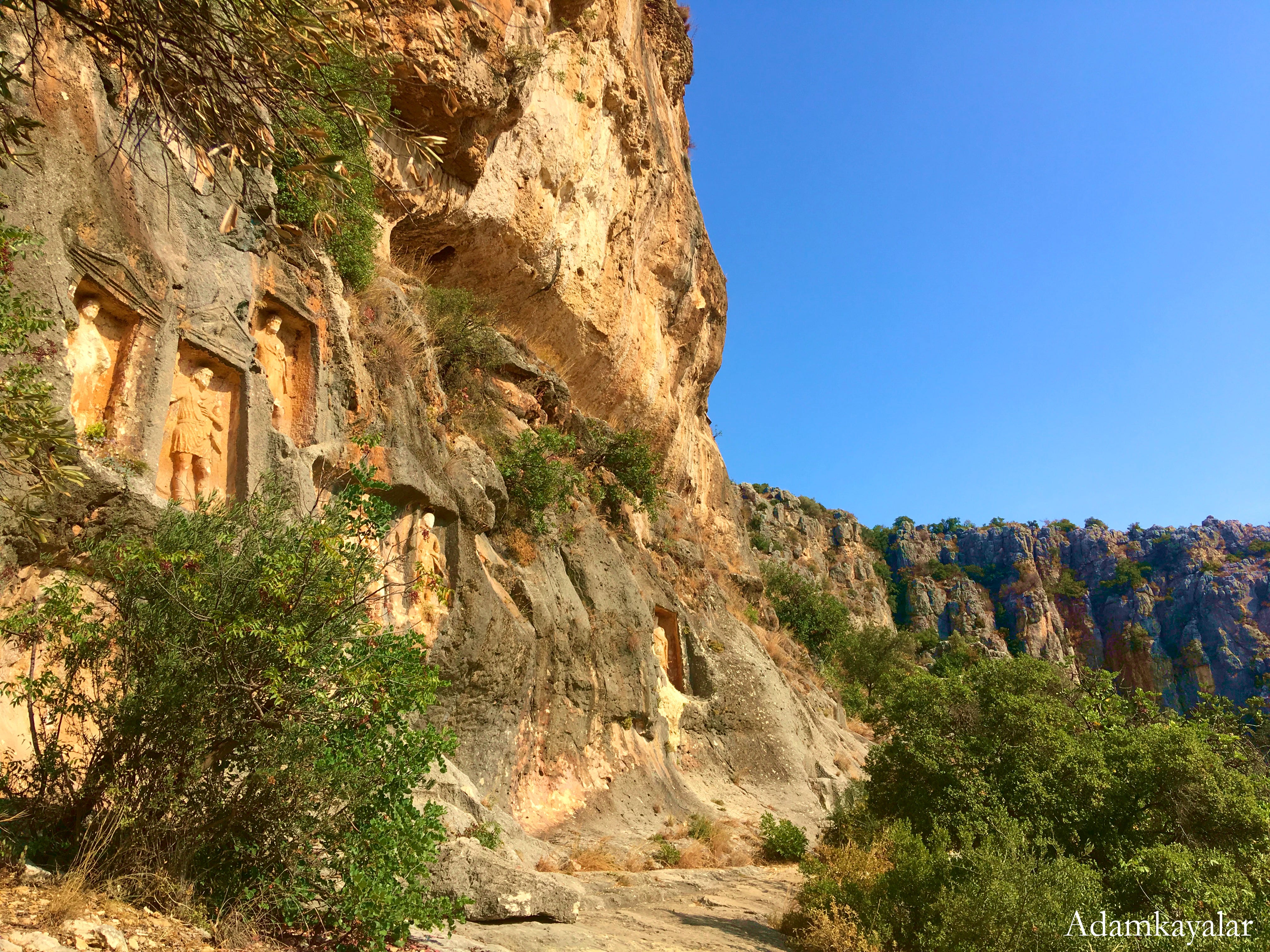
At Adamkayalar, not a single carving can be accessed or even seen from the coastal plain. It’s a rocky, arduous journey to the tombs. Even when you get there, the figures tower over you with grotesque, colossal limbs, like over-inflated balloons.
The waves of the sea crash onto the shore far below. It’s hard not to feel the pride of the stonemasons and the tomb-dwellers, to marvel at what they accomplished.
When you are up there, you can see for miles. Centuries of competition with the waves unfold before your eyes. The Hoover Dam, still two millennia in the future, appears as a grandchild with a striking family resemblance.
But it’s hard to see anything beyond the struggle for dominance. You start to forget that another relationship is possible.
One where the lonely masters of the world finally remember what it means to be humble, to be receptive, to be close.
~*~
In two weeks: What we do with the stones when the gods leave.
Previous: Picking Through the Remains.
Start from the Beginning: Watching a City Drown
Text © 2026 Akiva Sanders. Drawings © 2026 SaraNoa Mark. Photos © 2026 Akiva Sanders and SaraNoa Mark, unless otherwise indicated. All rights reserved.
All ideas shared here were developed jointly in conversation.
Further Reading:
Harmanşah, Place, Memory, and Healing (Routledge, 2015)—the book that inspired many of our rock monument visits.
Sanders and Mark, “Living Rock Monuments and Water in Mediterranean Anatolia: Three Case Studies.” (Contributi e Materiali di Archeologia Orientale XX, 2023) — Our academic paper on competition and changing relationships between monuments and water.
Miller, Royal Hittite Instructions and Related Administrative Texts (Society of Biblical Literature, 2013) — The original texts on the separation between the Hittite kings and everyone else.
Warbinek, “Hittites and Their Oracles: They Believed in Them, Although They Did Not Trust Them” (Archiv für Religionsgeschichte 23, 2022) — Asking the gods the same question again and again.
