
Every stone comes from somewhere. Every marble countertop, Michelangelo sculpture, and particle of concrete was cut from a rock face. A million-year, unmoving witness chiseled off, pulled away, loaded and shipped.
A place turned into a material.
It is perilous, backbreaking work. In antiquity, large stones were often the heaviest objects to move long distances. Each time, hundreds of laborers pushed their bodies to the limit, fearing an even-worse punishment or expecting a handsome reward from the reigning king.
Sometimes, before the work was done, the unimaginable occurred—there was no longer a king to pay for it.
~*~
Hattushili III was Muwatalli II’s brother and successor on the throne. They fought side by side at the dispiriting Battle of Kadesh. On the way home, while his brother was measuring out his first rock-relief at Sirkeli Höyük, Hattushili was falling in love with a woman from a neighboring town. Her name was Puduhepa. She became one of the most powerful queens of the ancient world.
As queen, she gave order to the realm of the thousand Hittite gods. She placed the storm god Teshub and the sun-goddess of Arinna at the top, imagining a divine parallel to the Hittite king and queen.
Her son, Tudhaliya IV, carved their images into stone all over the empire. Of all the Hittite kings, Tudhaliya was by far the most prolific stone carver. He was the one to etch the Hittite pantheon into the rock folds of Yazılıkaya.
There, an endless procession of gods climbs along the curving stone towards a marriage ceremony: Teshub and the Sun Goddess facing one another, arms outstretched, love in their eyes, standing on the bowed heads of lesser gods.
Tudhaliya was also the last successful Hittite king. The empire crumbled under the reign of his son Šuppiluliuma II. In 1190 BCE, Hattusha was sacked. It’s the last we hear from the Hittites.
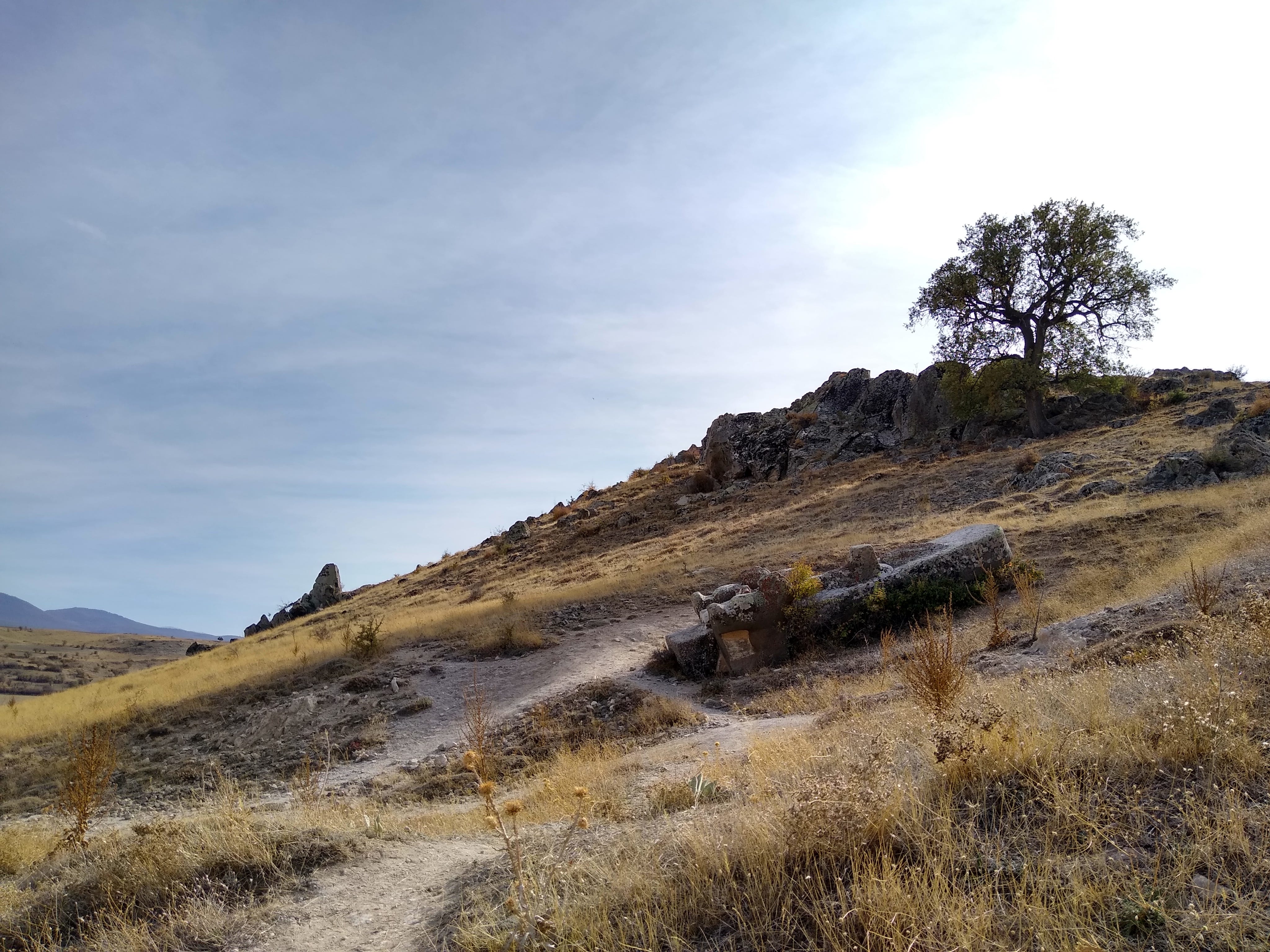
Šuppiluliuma had been trying to outdo his father by working on the largest sculpture of Teshub that had ever been made. The stonemasons were carving it in place at the Fasıllar quarry when news arrived that the empire was no more.
Perhaps they put their chisels and hammers to new use defending their homes from the roving bands that replaced it. Or maybe they used them to stake a claim on a temple’s hoarded wealth, no longer protected by the king’s authority. In any case, they abandoned the half-finished Teshub in the quarry.
Instead of becoming a towering king of the gods, dragged away to a temple somewhere, it remained part of the place, an accidental living rock-relief, a monument to the hubris of a vanished empire.
~*~
When SaraNoa and I arrived at the quarry, the sun was just disappearing over the lichen-covered cliffs. There it lay, the immense sculpture of Teshub, stretched out on its back, half-carved, with its right arm raised and its left foot stepping confidently forward, just as the masons had left it at the dawn of a new kingless world. Exhausted from a long day’s journey, we collapsed into its calm, lifeless embrace. We looked up to admire what was left of the twilight blues and magentas.
Above us, on the vertical face of the quarry we could just make out a solitary witness — a relief of an archway and a striding horse, watching over the lying Teshub.
It was carved under the Roman Empire, after Teshub had been alone in the quarry for a thousand years. We returned in the morning to document.
The horse was carved in the memory of a young man. The inscription reads: “Lucianus, who died before marriage.” In his honor, chariot races were held around the stillborn statue. The charioteers knew nothing of Teshub or Šuppiluliuma II or even the Hittite Empire. Yet the monument that was abandoned before its birth lived again, as a memorial to a man who died before growing old.
~*~
Many of the most beautiful places on earth still exist because they are inconvenient for agriculture or habitation. The same cliffs and soaring peaks that lift our souls are unsuited for the straight furrows and street corners that organize our lives. So empires claim them as their own. Kings carve their faces into the cliffs. Bureaucrats cordon off the peaks as national property.
Yet these awe-inspiring places are not entirely immune to the appetites of civilized life. It is precisely the bare rock faces that have so much visual power where stone, minerals, and metals are most accessible for extraction. The mountains that escape the surveyor’s ruler often fall victim to the miner’s pickaxe.
This leads to an awkward situation. The glorious front end and ruthless back end of empire — the monuments and the mines — often inhabit the same places.
National parks like Yosemite are littered with mineshafts. The closest commercial quarry to Mount Rushmore lies less than a mile from the presidents’ heroic faces.
As SaraNoa and I traveled across Turkey, we repeatedly stumbled upon these jarring juxtapositions. In some cases, industrial quarrying operations had eaten entire mountaintops, stopping a mere foot or two away from an ancient Phrygian rock-cut tomb.
But sometimes, as it did at Fasıllar, this volatile overlap produces a scene whose poignance is undeniable.
~*~
Like Šuppiluliuma II, the early emperors of Rome had an appetite for grandiosity in stone. It was how they quieted their nagging doubts that their wars weren’t so just, they didn’t in fact have a right to rule the world, and their empire was just a flash in the pan. Everyone knew the emperor was no god. A military coup proved it at least once every generation. But maybe people would forget if there were enough temples carved in the emperor’s name.
Augustus once boasted that he found Rome a city of brick and left it a city of marble. The empire that followed him left marble cities across the Mediterranean coast as its calling card for the ages.
One of the most monumental was Ephesus. Its crowning jewel was the 118-pillared Temple of Artemis, one of the Seven Wonders of the World. The city was situated on Turkey’s west coast among the marble quarries that provided the raw material for the empire. The nearest one was along the main road into town, just on the other side of Mount Pion.
It had been a rock-cut sanctuary to the Earth Goddess before the stone extraction crews started chipping away.
Early Christians called Rome’s bluff. They said that there was a true global empire where your rank doesn’t depend on how much wealth you extract, but how much you give away. It made sense to enough Romans that they became a real threat to the whole imperial project. So Rome persecuted them. When that didn’t work, the emperors learned to justify their rule in Christian language.
By the 5th century CE, most of Rome’s marble cities, built to be eternal, had become quarries themselves. A new generation with different values had already begun to drag away their stones to use in farmhouses and fortresses. The Temple of Artemis had been abandoned. Graffiti proudly declares that the image of Artemis was desecrated and replaced with a cross. According to medieval legend, its pillars were shipped to Constantinople for the construction of Hagia Sophia, that monument to a new Christian Rome.
In 431 CE, Emperor Theodosius II convened a council in Ephesus to decide imperially endorsed doctrine on the day’s most pressing religious debates. They were discussing if Jesus was part god and part human or all god and all human or somewhere in between. There were few discussions related to the things we might credit religion with: a sense of belonging, kindness to others, a disregard for the illusion of wealth. And yet the council was a defining moment in the history of global Christianity.
It tore the Christian community apart. The council condemned and defrocked the popular theologian Nestorius, and his followers tried to blend in or fled the empire. The council reconvened 18 years later. The decisions taken at the second council stood for only two years until they were repudiated by the next emperor.
In the marketplace of Ephesus, theology and religious persecution were the topics of the day. There was widespread doubt over the empire’s drastic actions. Just as marble monuments couldn’t convince the people of the empire’s legitimacy, neither could arcane debates.
They needed a miracle.
It came from the abandoned quarry on the other side of Mount Pion.
According to legend, a farmer decided to reuse the quarry as a shed for his cows. There, as at Fasıllar, he found a relic frozen in time. Seven Christians had fled from the persecutions of the Emperor Decius 250 years earlier and were sleeping until the farmer woke them. They headed into town, trying to buy a meal with centuries-old coins.
The quarry became famous immediately, and the miracle was recorded as historical fact within a generation. Pious Christians carved a new church into the stone that was soon overflowing with new rock-cut tombs of the newly dead, whose final wish was to be close to the sleeping place of the early saints.
The story was retold over the centuries, by Christians and Muslims alike, and pilgrims have visited ever since.
At the very moment when the built-to-last monuments of Ephesus were becoming quarries, one of its quarries became an enduring monument.
We had journeyed to the quarry to find the origins of the marble facades of Ephesus. What we found was a palpably miraculous place. An ancient sanctuary violated by stonecutters to feed an insatiable empire, then recognized as a sanctuary once again when the empire exhausted itself.
It’s the very definition of a miracle – a reversal of fate at the moment of greatest helplessness. The restoration of a dignity that was taken for granted and exploited. It’s a story that reappears everywhere from the Odyssey to the Psalms to the Arabian Nights. Here, evidence of this reversal was carved clearly into the time-worn stones.
As we neared the place, we entered a forest of trees covered with the rags of pilgrims. Each one expresses a desperate hope that this sanctuary-turned-quarry-turned-sanctuary would reverse something in their own lives — an illness, a family dispute, a crisis of faith.
~*~
In two weeks: Searching for ghosts in the stones.
Previous: Intimacy and Triumph.
Start from the Beginning: Watching a City Drown
Text © 2026 Akiva Sanders. Drawings © 2026 SaraNoa Mark. Photos © 2026 Akiva Sanders and SaraNoa Mark, unless otherwise indicated. All rights reserved.
All ideas shared here were developed jointly in conversation.
Further Reading:
Rojas and Sergueenkova, “Traces of Tarhuntas: Greek, Roman, and Byzantine Interaction with Hittite Monuments” (Journal of Mediterranean Archaeology 27.2, 2014) – Returning to the Hittite reliefs over the millennia.
Miltner, Das Coemeterium der sieben Schläfer (Österreichisches Archäologisches Institut, 1937) – The original excavation report of the Cave of Seven Sleepers, Ephesus.
